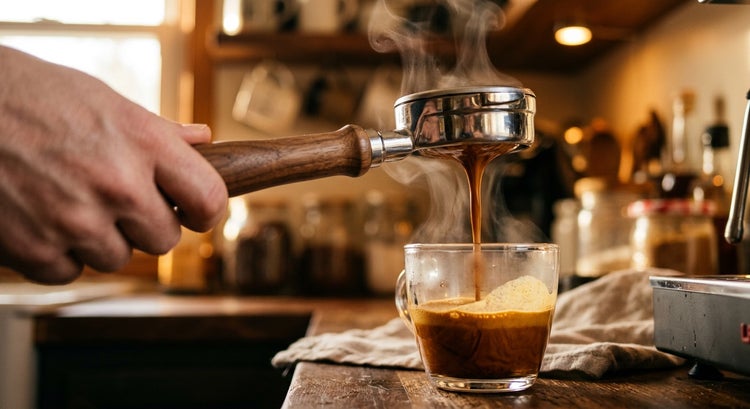
There is a particular pleasure in watching water move through coffee. Not the machine-forced kind — the kind that pools at the surface, darkens, and draws its own path downward. It takes about four minutes. Most people won't give it that.
But those who do notice something: the cup is different. Not just slightly. Noticeably smoother, sweeter at the finish, less of that dry bite that sits at the back of the tongue after a rushed filter. The slow pour rewards patience in ways that are easy to taste and hard to explain chemically without sounding like a lecture.
So here's the short version, without the lecture.
Water is doing most of the work
Coffee is roughly 98% water. The bean contributes flavour compounds — hundreds of them — but it's the water that decides which ones make it into the cup. Hot water extracts quickly and indiscriminately. Cooler water, and slower movement, let the lighter, brighter compounds come through first before the heavier, more astringent ones arrive.
The bloom pour — that first 30–40ml of water you add before a full pour-over — starts degassing the coffee. Carbon dioxide trapped in freshly roasted beans escapes in small bubbles. If you skip it and pour straight through, those gases interfere with extraction. You get an uneven cup.
Temperature matters more than most guides admit
The standard advice is 93–96°C. That's a good range. But the more useful version: if your kettle just boiled, wait 45 seconds. If your coffee tastes flat and thin, try going a little hotter. If it tastes sharp and bitter, go cooler. The range is narrower than people fear, but it's not fixed.
The Atelier manages this for every brew — adjusting extraction temperature based on your taste profile. But for manual brewing, a simple variable-temperature kettle is worth every cent.
The pour itself
Slow circles. Start in the centre, move outward, come back. You're not just adding water — you're agitating the bed evenly. Uneven agitation means some grounds over-extract while others under-extract. The result is a cup that's simultaneously bitter and sour, which feels like a contradiction until you've tasted it.
Four minutes, from bloom to final drip, is a reasonable target for a filter. Your coffee tells you when it's ready — the drip slows to almost nothing and the bed looks flat and even. That's the pour-over telling you it's done.
The patience argument
The strongest case for the slow pour isn't technical. It's that the ritual of it — the attention, the waiting, the small physical care — changes how you experience what follows. A cup you made slowly, carefully, with good water at the right temperature tastes better partly because you're already settled by the time you drink it.
The morning is better for it. So is the coffee.