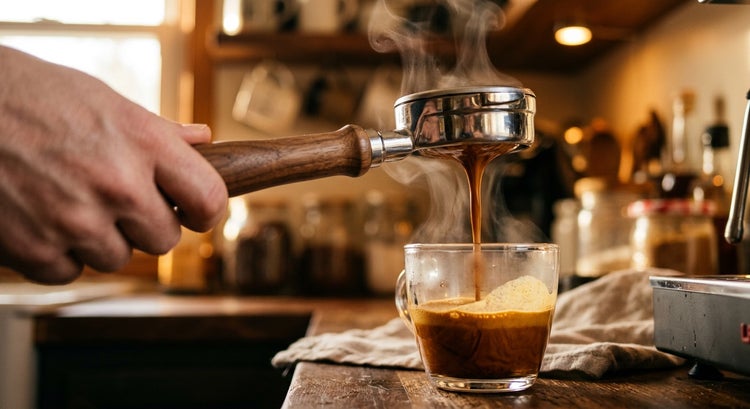
The first espresso you pull at home is almost never good. This is not a problem with you, or with the machine. It's a problem with the variables — and the fact that no one tells you, clearly, what they are and what to do about them.
The good news: there are only three that matter at the start. Once you have these three under control, you have a foundation. Everything else — pressure profiling, pre-infusion, water chemistry — is refinement, not foundation. Start there.
The grind
Espresso is extracted under pressure in roughly 25–30 seconds. For that extraction to work, the water needs resistance — and the grind creates that resistance. Too coarse, and the water flows through too quickly, taking only the easy-to-extract (sour, thin) compounds. Too fine, and the water struggles, over-extracting the bitter, drying ones.
The grind is your primary variable. Change it first when something is wrong. Move in small increments — one or two notches on a stepless grinder. Give yourself time to taste the result before adjusting again.
A good starting point: grind fine enough that the shot takes around 27–30 seconds to extract from the moment you start the pump. If it runs faster, grind finer. If it chokes and slows past 35 seconds, coarsen slightly.
The dose
Dose is the amount of ground coffee in the basket, measured in grams. Most double-shot baskets are designed for 18–20g. Using significantly less or more changes the geometry of the puck — how densely the water has to work through the grounds.
Pick a dose and hold it constant while you're dialling in the grind. Changing both at once makes it impossible to isolate which variable caused the change in the cup. Get the timing right at a fixed dose first. Then experiment with dose once you have a stable baseline.
A kitchen scale that measures to 0.1g is genuinely useful here. Not mandatory — but it removes one variable from guesswork.
The time
Extraction time is the result of grind and dose working together. The target: 25–30 seconds from pump start to the point where you stop the shot. The yield (the liquid espresso in the cup) should be roughly double the dry dose — so an 18g dose should yield around 36g of liquid espresso.
This is the ratio that the specialty coffee world has converged on for good reason. It's not a law — some styles pull longer, some shorter — but it's the right place to calibrate from.
Watch the extraction as it happens. A well-extracted shot pours slowly, starts as a dark, viscous stream, and lightens slightly towards the end. If it's pouring fast and pale from the start, the grind is too coarse. If it's dripping and taking forever, too fine.
What the Atelier does differently
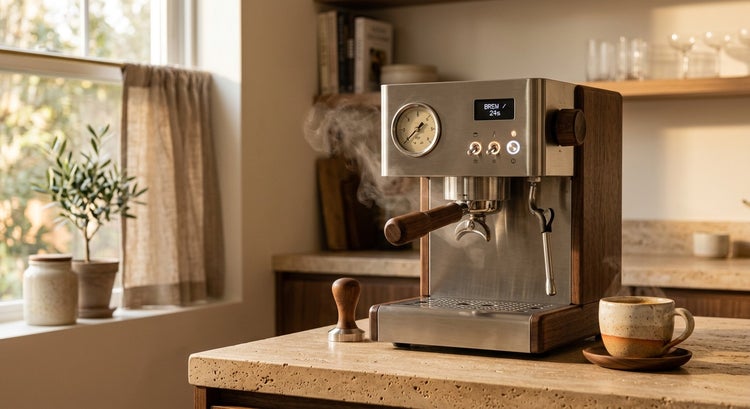
The Atelier handles grind calibration automatically, adjusting dose, extraction time, and temperature to your evolving taste profile. But understanding these variables changes the way you interact with any espresso machine — you stop accepting a mediocre shot and start knowing what to do about it.
The skill of dialling in transfers. Whether you're at home, visiting friends, or ordering at a café and noticing the shot pulled thin, you'll recognise what happened and why.
One last thing
Taste the shot on its own before you add milk. Even if you always drink flat whites or lattes — just once, at the start, before you know what you're doing, taste it straight. You'll know immediately what it's doing right and wrong. That information is the fastest feedback loop there is.
Bitter and drying at the back: over-extracted. Go coarser, or slightly shorter. Sour and thin: under-extracted. Go finer, or slightly longer. Sweet and balanced in the middle: you're there. Now make the coffee you actually want to drink.
More from the journal
Brewing
In praise of the slow pour
Why the unhurried cup rewards your patience — and how to get the water right.
May 2026 · 4 min
The Atelier
How the Atelier learns your taste
It doesn't guess, and it doesn't need a questionnaire. Here's what actually happens in the first two weeks.
June 2026 · 6 min