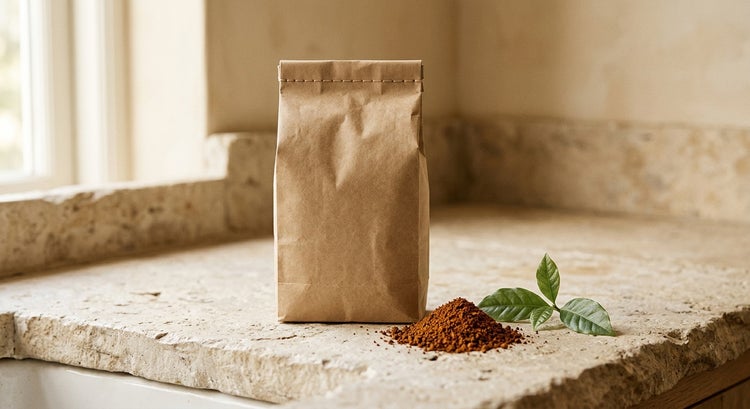
After the cup, there is a small drawer that needs emptying. This is the part of home coffee that no one talks about in the product photography — the spent grounds, the used pods, the bits that were delicious a moment ago and are now just wet dark matter waiting to be dealt with.
Most of them end up in general waste. That's a problem, because coffee grounds are genuinely useful material — rich in nitrogen, a reasonable soil amendment, and not something that needs to go to landfill.
The Atelier was designed with this in mind. Here's what we actually do about it.
The grounds drawer
The Atelier collects spent grounds in a dedicated drawer rather than a single-use capsule. The drawer holds around seven brew cycles before it signals that it's full. At that point, the grounds come out as a single compact puck — easy to handle, minimal mess.
What you do with that puck is up to you, but we've built the collection process to make the right option easier than the wrong one. The grounds are dry enough to go straight into a compost bin without making it soggy. They don't require any processing or drying.
What spent grounds are good for
Used coffee grounds are a useful input for several things that aren't landfill:
- Composting. Grounds are a nitrogen-rich "green" material — they balance the carbon-heavy "browns" (cardboard, dried leaves) in a home compost heap. Add them directly; no preparation needed.
- Garden soil. Mixed into soil around acid-loving plants (blueberries, roses, rhododendrons), used grounds improve structure and add trace minerals. Don't overdo it — a thin layer, worked in.
- Community collection. Several urban garden schemes and council compost programmes accept used coffee grounds. The Fréscopa café deposits its daily grounds with a local urban garden. If you're in a flat with no garden, this is the nearest equivalent.
- Odour absorption. A small dish of dried grounds in a fridge or freezer absorbs odours without adding scent. Not a primary sustainability measure, but a genuinely useful application.
The pod question
Single-use pods remain the dominant format in home coffee. They're convenient and consistent, and the category grew for good reasons. The environmental argument against them is also real: most are made from a combination of plastic, aluminium, and organic material that's difficult to separate for recycling and that landfills in the worst-case scenario.
Some pod manufacturers have take-back programmes. They work better than critics suggest, but they still require the user to collect, store, and return. Most don't.
The Atelier's refillable system doesn't solve every sustainability challenge in coffee production — it doesn't change how the beans were farmed or how far they travelled. But it removes the pod problem entirely at the home end. There's nothing to return. Nothing to separate. Just a drawer to empty and a puck to compost.
What the Atelier tracks
The Atelier maintains a record of total brewing cycles and estimated grounds produced over its lifetime. This isn't a dashboard you'll check daily — it's more of a quiet accounting, surfaced in the app when you're curious. Over a year of daily brewing, the avoided-pod figure gets interesting.
We'll tell you the number. It's not a boast — it's just useful information to have about a decision you made at the start.
More from the journal
Origins
Single origin, explained
What "traceable to a single farm" really means, and why it changes the cup.
Apr 2026 · 5 min
The Atelier
How the Atelier learns your taste
It doesn't guess, and it doesn't need a questionnaire. Here's what actually happens in the first two weeks.
June 2026 · 6 min